Both sit under 3,750 feet. Both are old, rounded, forested uplands two to three hours from a major city, both have a long-distance trail with a stamp book, both fill their guesthouses with Germans on foot rather than foreign visitors, and both get requested at this desk in the same sentence: a walking week in Germany, nothing alpine, roughly seven nights, mid-price. That is why the harz or the eifel arrives as a single question rather than two.
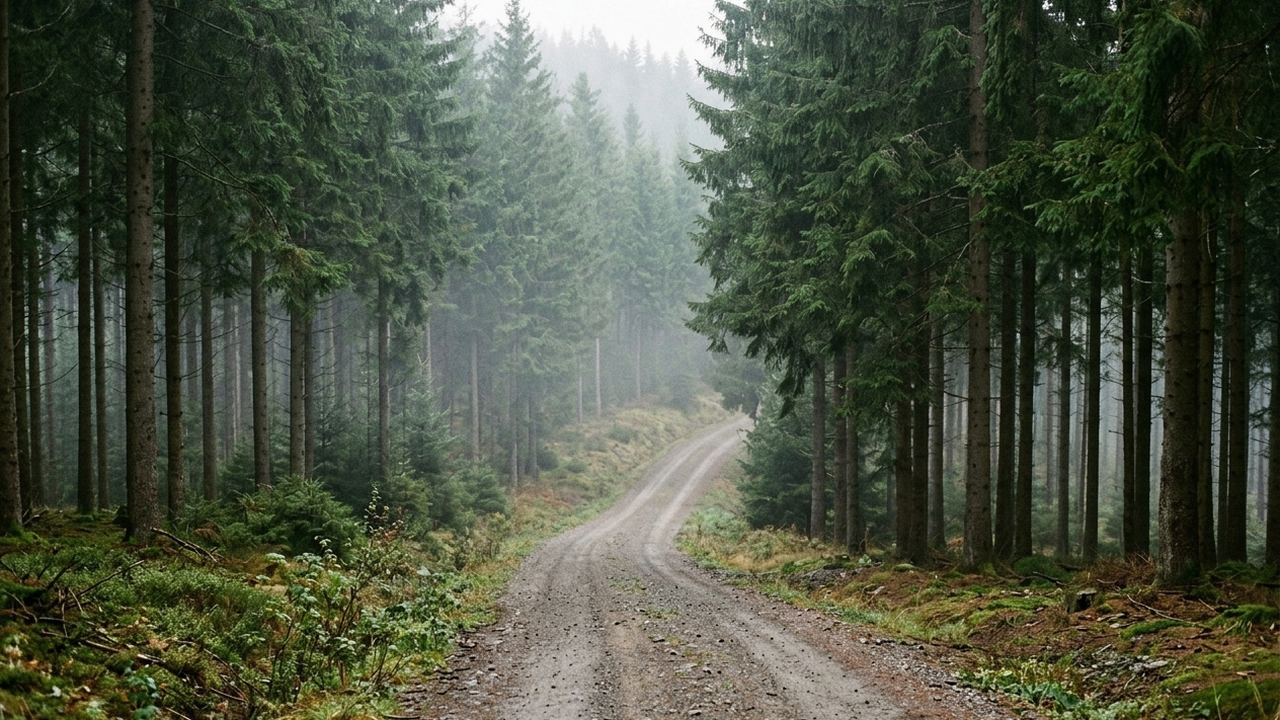
What the request almost never contains is a date, and the date matters more here than in most places we book. It also rarely says what the walker wants the ground to look like. People picture German upland forest as continuous dark spruce, closing overhead, cool at noon in August. That description is now accurate in one of these two ranges and substantially inaccurate in the other, and nobody discovers this from a map, because a map still prints both of them green.
The two halves, set on the same axes
harz
The Harz sits in central Germany about 2 hours 30 minutes by car from Hanover and roughly 4 hours from the Eifel; its high ground reaches 3,747 feet against the Eifel's 2,438; the walking is one fixed base reached by public rail rather than a moving route, and the price floor here is $1,940 for six nights; the spruce forest across large parts of the plateau is standing dead or already cleared, so the hillsides are gray and open rather than green and closed.
from $1,940 per person
eifel
The Eifel sits about 75 miles from a major international airport and the transfer is roughly 1 hour 40 minutes; the Harz is closer to 4 hours from the nearest comparable arrival point. Daily ascent here runs 900 to 1,500 feet on graded surfaces; the Harz week is built around single climbs of 2,000 feet and more. The Eifel high point is 2,428 feet, the Harz high point is 3,743 feet. This week is $1,880 for six nights on one base; the Harz week runs seven nights and moves you between two or three houses.
from $1,880 per person
Two figures set beside each other are two facts about two different trips of different lengths, run by different companies, in different seasons. Neither figure is offered as the better value and this office will not say that one is. What each covers is listed on its own page.
What the last ten years did to the tree cover
The Harz spruce was planted, not native, in monoculture blocks going back to eighteenth century mining demand for timber. Successive dry summers from 2018 weakened it, bark beetle finished large parts of it, and the standing dead was cleared or left across a very large share of the higher plateau. Federal and state forest reporting put the loss in the Harz at the highest level of any German upland region. The practical effect on a walking day: long stretches at elevation are now open, bleached, and hot in July and August, with young birch and rowan coming up around your knees and views in every direction that did not exist in 2015. Below roughly 1,600 feet the beech is intact and the walking is ordinary shaded forest.
The Eifel was mostly beech and mixed hardwood with spruce in patches, and hardwood does not fail the same way. Losses there were real but local. A week in the Eifel is still, for most of its hours, walking under closed canopy, which is cooler in summer, darker in November, and gives you fewer long sight lines.
Neither of those is a defect. An open Harz plateau in September, with the whole plateau visible, is a thing many walkers now go specifically to see. A closed Eifel beech wood in October is a different pleasure entirely. But they are not interchangeable weeks, and a walker who books one expecting the other spends seven days mildly disappointed for reasons they cannot name.
Airports, surfaces, rest days and the figures
nearest large airport is Hannover, about 60 miles to the nearest Harz trailhead town, roughly 2 hours by rail and bus; Leipzig and Berlin are also usedreach
nearest large airports are Cologne and Dusseldorf, 40 to 70 miles depending on which end you start, roughly 1 hour 30 minutes to 2 hours 15 minutes by rail and bus
the through route is largely forest road and firm gravel, with rocky sections in the river gorges; boots preferred, trail shoes workablesurface
more soft ground, leaf litter and narrow single track, with wet clay after rain in the volcanic west; boots preferred more strongly
one continuous waymarked long route plus a stamp scheme with over 200 checkpoints, which many walkers use to structure a weekmarking
a network of shorter certified loops of 6 to 14 miles, so a week is assembled from day circuits rather than followed as one line
11 to 15 miles per day, with 1,600 to 2,600 feet of ascent, hut to hut or town to towndaily distance we plan around
8 to 13 miles per day, with 1,000 to 2,000 feet of ascent, usually from two or three fixed bases
narrow gauge steam railway to the highest summit, working mine tours, half timbered towns, reservoirs open to swimmingbesides walking
two large lakes with boat services, Roman era sites and a preserved abbey, two national park dark sky areas, spa towns with public baths
indoor options concentrated in the larger valley towns, so a rest day usually means a train journey of 30 to 50 minuteswet weather fallback
spa and museum towns sit inside the walking area, so a rest day is often reachable on foot or by a 15 minute bus
from $1,285 per person, two sharingour price from, seven nights, half board, luggage moved
from $1,410 per person, two sharing
The gap between those two figures is about $125 per person and it comes from accommodation, not from the walking. Harz guesthouses in the mining towns run smaller and simpler; the Eifel weeks we sell more often use spa town hotels because that is where the beds are near the loops. Both figures cover seven nights, breakfast and evening meal, bag transfer between overnight stops, and route notes. Neither covers flights, drinks, entrance fees, or the rail and bus legs at either end. Both are confirmed against your own dates before anything is held.
People who should be looking at neither
A fair number of the requests that arrive under this heading are not really about these two ranges at all. The tell is usually in the second sentence.
Handing it back with both figures on one sheet
We are not going to tell you which of these two to take, and we would be inventing a preference if we did, because the thing that separates them is what you want to see over your head for seven days and that is not ours to decide. What the desk will do is take your dates, price both weeks against those exact dates with the actual guesthouses that have space, and send you the two side by side on one sheet, with the per person figure, what is in it, what is not, and the travel time from each airport. Then the comparison is yours to make with the numbers in front of you rather than from a map that prints both of them the same color. Write to us with the month you are thinking of and how many of you there are.