The Eifel is about 75 miles of upland west of the Rhine, and roughly 1 hour 40 minutes by road from the nearest major international airport. That number is the reason most requests reach this office in the first place, and it is also the reason people arrive with the wrong picture in their heads. Short transfer, low hills, Germany: the mental image is dry, open and easy. It is none of those three.
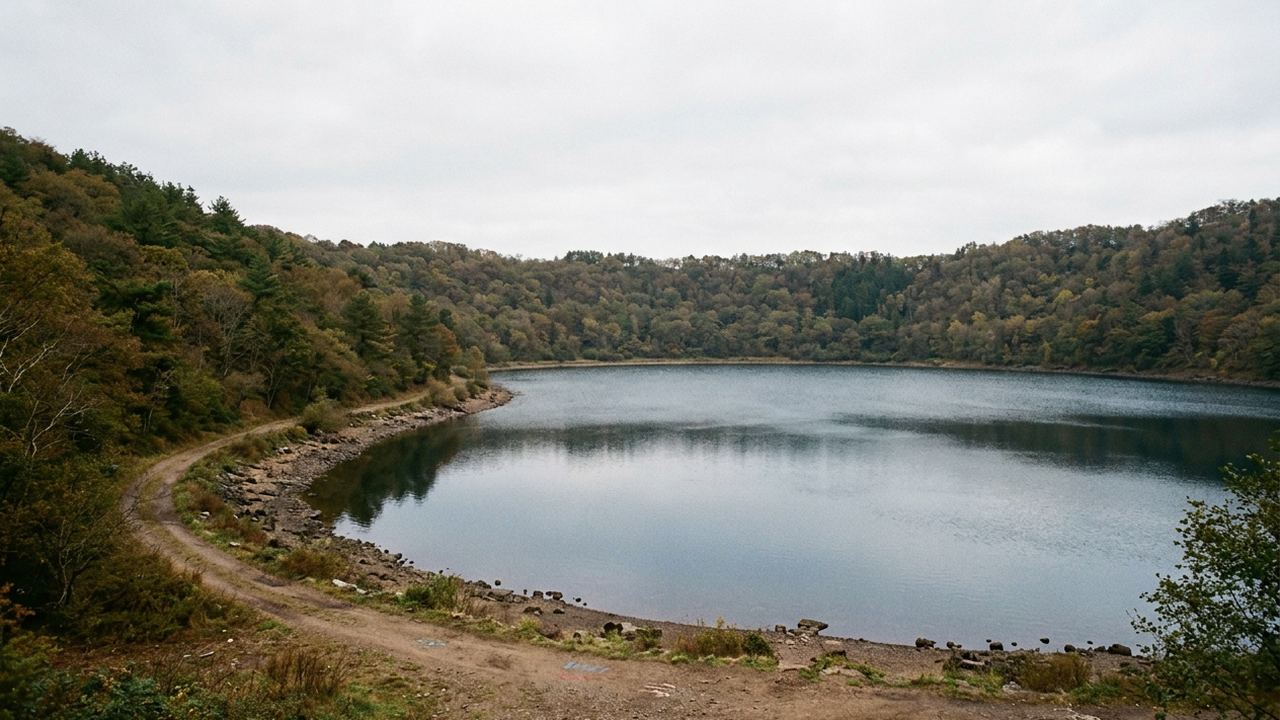
What the ground actually is: a volcanic field that stopped erupting about eleven thousand years ago and left behind roughly seventy round craters, of which a dozen or so hold water. Locally these are called maars. They are almost perfectly circular, some over 150 feet deep, and they sit in wooded country that gets 35 to 45 inches of rain a year. People who book a walking week in the Eifel and expect a Mediterranean summer are the ones who write to us afterwards. People who expect wet woods, mist off water at seven in the morning and a path that has been properly built tend to come back.
The other half of every conversation is the Harz, which arrives in the same sentence about half the time. Both are middle-altitude German uplands with walking paths and both get asked for by people who have seen one photograph. They are not the same week and this page is only about one of them.
- What the week is
- One guesthouse for all six nights, five walking days out and back by local bus or short transfer, luggage stays put.
- What sets it apart
- The Eifel sits about 75 miles from a major international airport and the transfer is roughly 1 hour 40 minutes; the Harz is closer to 4 hours from the nearest comparable arrival point. Daily ascent here runs 900 to 1,500 feet on graded surfaces; the Harz week is built around single climbs of 2,000 feet and more. The Eifel high point is 2,428 feet, the Harz high point is 3,743 feet. This week is $1,880 for six nights on one base; the Harz week runs seven nights and moves you between two or three houses.
- What the figure covers
- Six nights in a family run guesthouse, twin or double, breakfast each morning; five dinners at the house; airport transfer both ways; a local bus pass covering the walking days; printed route notes with grid references and a 1:25,000 sheet; one half day with a local walking guide on the volcanic ground.
- What it leaves to you
- Flights and any onward travel to the arrival airport; lunches on all six days, and there is no shop on three of the five routes; one dinner left free for the village; drinks at any meal; entry to the maar visitor center and the lava dome; boots, waterproofs and any hire of poles; the second guided half day if you add one; gratuities; anything you spend on rest days when weather closes the higher routes.
- Who this one is wrong for
- This is not a week for anyone who wants dry heat, long views every day, or a summit. The high ground tops out under 2,500 feet and cloud sits on it. Three of the five routes cross wet peat and root-laced woodland that stays greasy for days after rain, and two involve 40 to 60 minutes of walking with no shelter of any kind. Between late November and mid March the bus service on two routes drops to school days only, which shortens the week to three usable walking days. If you need to be back at the house before dark in December, the daylight window is under eight hours.
What the volcanic ground does underfoot
The signature surface here is basalt and scoria, which drains fast on the tracks and holds nothing on the tops. A graded section stays walkable within an hour of heavy rain. That matters more than it sounds, because the alternative surface, and there is plenty of it, is beech leaf litter over clay in the valley bottoms, and that stays greasy for two to three days.
Daily ascent across the five walking days runs 900 to 1,500 feet, spread rather than concentrated. The longest single continuous climb on any of the routes is about 620 feet, taken over roughly a mile and a quarter of switchback. The highest ground you will stand on is 2,428 feet. There is no scrambling, no exposure and no section where hands come out of pockets.
The long distance path that threads the region is genuinely well made: waymarked at every junction, surfaced where surfacing is needed, and with stiles and boardwalk over the wet peat sections rather than a churned line of bootprints. Sections of it run beside three of the maars. Walking days are 6 to 11 miles, and the local bus takes you back, which is why the week works from one base.
People who arrive here having asked for something else
Roughly half the requests that end up on this page began as a question about somewhere else, or about a kind of week this region does not deliver. That is worth setting out honestly rather than letting somebody find it out in the rain on day two.
Six months that work, six that work differently
The walking season is not a wall with a date on it. It changes what the week consists of rather than whether it happens, and the two things that move are the bus timetable and the daylight.
- Late April to end of May
- 55F to 65F afternoons, beech coming into leaf, full bus service, ground still wet from March
- June to August
- 68F to 77F, around 3 to 3.5 inches of rain a month, longest daylight, the maar shores are busiest at weekends
- September to late October
- 50F to 63F, the driest run of weeks in the year, full bus service until October 25
- November to mid March
- 34F to 43F, under eight hours of daylight in December, bus on two routes drops to school days only
- Snow above 1,800 feet
- Usual from late December to early March, 20 to 40 days lying in an average winter
- Fills first
- Mid September to mid October, generally four to five months ahead
From your message to a written figure
- 1. You write
- We read it before the working day ends and reply with questions, usually about how many miles a day suits you and which month you are aiming at
- 2. We check the ground
- We confirm the guesthouse has your dates, that the bus timetable covers your walking days, and that the guided half day has a slot
- 3. You get a figure
- A written breakdown reaches you in two to four working days, itemized, with the excluded list repeated in full
- 4. You decide
- Nothing is held and nothing is charged until you tell us to go ahead in writing
The doubt worth raising before you commit
If you are weighing this against the Harz, or against a week that moves between houses, say so in your first message and say what you actually want out of the days. This office will set the numbers side by side for you: hours, ascent, surfaces, months, cost. What we will not do is tell you which one to take. That part stays yours.