Slovenia's high limestone sits in one national park of about 340 square miles, and the whole of it is reachable within an hour of one small capital airport. That single geographic fact shapes everything else on this page. People who book a walking trip in the Julian Alps have usually spent a winter looking at photographs of pale towers above green pasture, and those photographs could as easily have been taken 90 miles west on the Italian side. The rock is the same Triassic limestone, laid down in the same shallow sea, lifted by the same collision. What differs is how many people walk on it and how much has been built to make walking on it comfortable.
Around 30 staffed huts serve the Slovene range. The Dolomite side of the same limestone family carries several hundred, which is why a walker there can often stop after 3 hours and find a bed, a menu and a wine list. Here the huts sit farther apart because there are fewer of them, so the day is set by hut spacing rather than by preference: 5 to 8 hours of walking, 2,300 to 3,900 feet of ascent, and no realistic option to stop halfway. Quieter is a real description of this range, and this is what it costs.
- What the week is
- Six walking days linking mountain huts on foot, two nights in valley lodging at either end, and a road transfer that moves your main bag between valley points while you carry a day pack over the passes.
- What sets it apart
- The whole range is about 340 square miles against roughly 55 square miles of Dolomite country in the same limestone family, and it holds around 30 staffed mountain huts against several hundred; the trailhead is 45 minutes by road from Ljubljana against two and a half to four hours from the nearest large airport on the Dolomite side; walking days here run 5 to 8 hours with 2,300 to 3,900 feet of ascent, against the 3 to 5 hour hut spacing common on the Dolomite high routes; the floor is $2,760 for eight nights here and quoted separately for the Dolomite week; hut staff speak Slovene and German first, with English varying by hut.
- What the figure covers
- Eight nights of lodging, two in a valley guesthouse and six in staffed mountain huts in shared bunk rooms; half board at every hut, meaning dinner and breakfast; road transfer of one main bag between the two valley points; airport transfer both ways from Ljubljana; printed route notes with grid references and daily ascent figures; digital track files for each stage; a local walking guide for the two days on exposed sections.
- What it leaves to you
- Airfare; lunches and all drinks including bottled water at huts, which is charged separately because most huts run on rainwater and generators; hut shower tokens; the sleeping bag liner every hut requires; boots, poles, waterproofs and a headlamp; any cable car or chairlift used to shorten a day; entry to Vintgar Gorge and other gated sites; any night in the valley outside the eight booked; anything a hut charges to store or dry gear; costs caused by weather closing a pass and forcing a road transfer.
- Who this one is wrong for
- Anyone who will not sleep in a bunk room with eight to twenty other people and one shared washroom; anyone who cannot walk 8 hours on loose limestone scree with 3,900 feet of ascent on two of the six days; anyone unwilling to hold a fixed cable on a rock step with a drop beside it, since two stages have no valley alternative; anyone who wants a private bathroom, a daily bag drop to the door or a road within reach of every lunch stop; anyone traveling before mid June or after early October, when most huts are shuttered and the passes hold snow.
Scree, cable and the shape of a limestone day
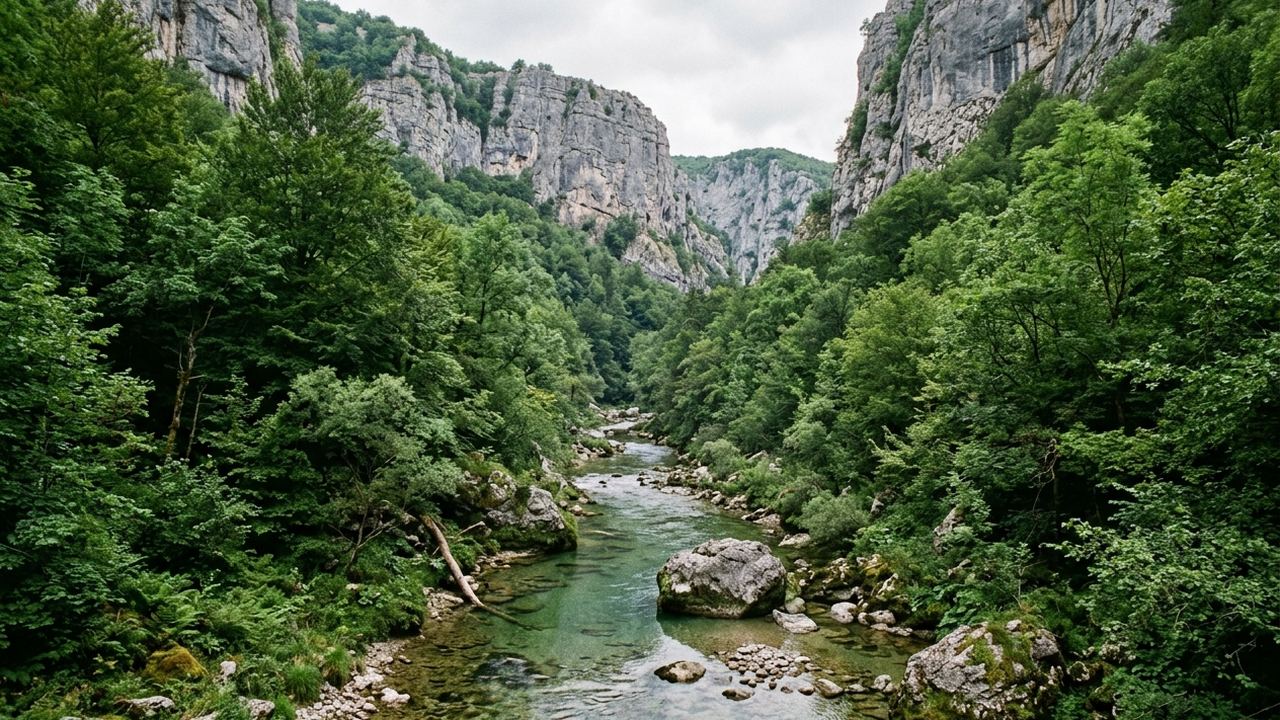
The paths are marked with a red circle around a white center, painted on rock every few hundred feet, and that marking system is consistent across the range. What is not consistent is the surface underneath it. A stage typically starts in beech and spruce forest on a graded forest road, climbs onto pasture, then breaks out onto open limestone above 5,500 feet where the walking becomes loose scree and slabs for two to three hours at a stretch. Poles matter more than boots on the descents, and the descents are where the hours go.
Two of the six stages cross ground fitted with fixed steel cable bolted into the rock, the local term for which is a via ferrata section rather than a full route. On those two days a local guide walks with the group. The exposure is real: a cabled traverse of maybe 400 feet with an open drop to one side, taken one person at a time. There is no valley bypass on either of those days that does not add 4 hours and a road transfer, so the itinerary treats them as fixed. The highest point of the week stands at 8,787 feet, reached on day four, and the last 900 feet of it are hand and foot on cable.
Water is the other thing the ground decides. Limestone drains, so there are no streams on the high ground for long stretches. Huts collect rainwater into cisterns and sell bottled water because the cistern supply is for cooking and washing. Carrying three quarts from the morning hut is standard, and it is why the day pack weighs what it does even with your main bag traveling by road.
Arriving here having asked for somewhere else
About half the people who write to this office about Slovenia open the message by naming a valley in Italy. That is not a mistake worth correcting. It usually means the picture they are holding is accurate and the assumptions attached to it are not.
Eight weeks of season, and what the other forty-four do
The walking season here is short and its edges are hard rather than gradual. Huts open when the supply track to them clears, and close when the water lines would freeze. Nothing about that is negotiable by booking early.
- Late May to early June
- Passes above 7,000 feet still hold snow; most huts shut; stages not walkable as routed
- Mid June to early July
- Huts opening in sequence; long daylight; meltwater still running; afternoon storms starting
- Mid July to late August
- Every hut staffed; daytime highs of 75 to 82 F in the valley and 50 to 61 F at hut altitude; bunk rooms full and booked out months ahead
- September
- Storm frequency drops; nights at hut altitude fall to 34 to 41 F; the busiest stages quiet noticeably
- Early to mid October
- Huts closing in sequence; first snow above 6,500 feet in most years; walkable only in the lower valleys
- Mid October to May
- Range shuttered for this itinerary
Bunk space for the July and August dates is the constraint that fills first. Huts hold a fixed number of mattresses and cannot add more, so a request made in January for an August week is normal timing rather than early.
From your message to a written figure
- 1. You write
- You name a month, the number of people and whether anyone in the group has not slept in a bunk room before; a message is opened before the working day ends
- 2. We check beds
- Six huts are contacted in sequence for your dates, because the itinerary only exists if all six have space on consecutive nights
- 3. You get the figure
- A written quote showing lodging, half board, both transfers and guided days as separate lines, along with the dates the huts confirmed; two to four working days
- 4. You decide
- Nothing is held while you think, and nothing changes if you take a week over it
Ask us the awkward question
If what you actually want to know is whether the bunk rooms are as basic as they sound, or which of the two ranges has the shorter walking days, write and ask. This office sells both weeks and will set the figures side by side without telling you which one to take. The comparison is yours to make.