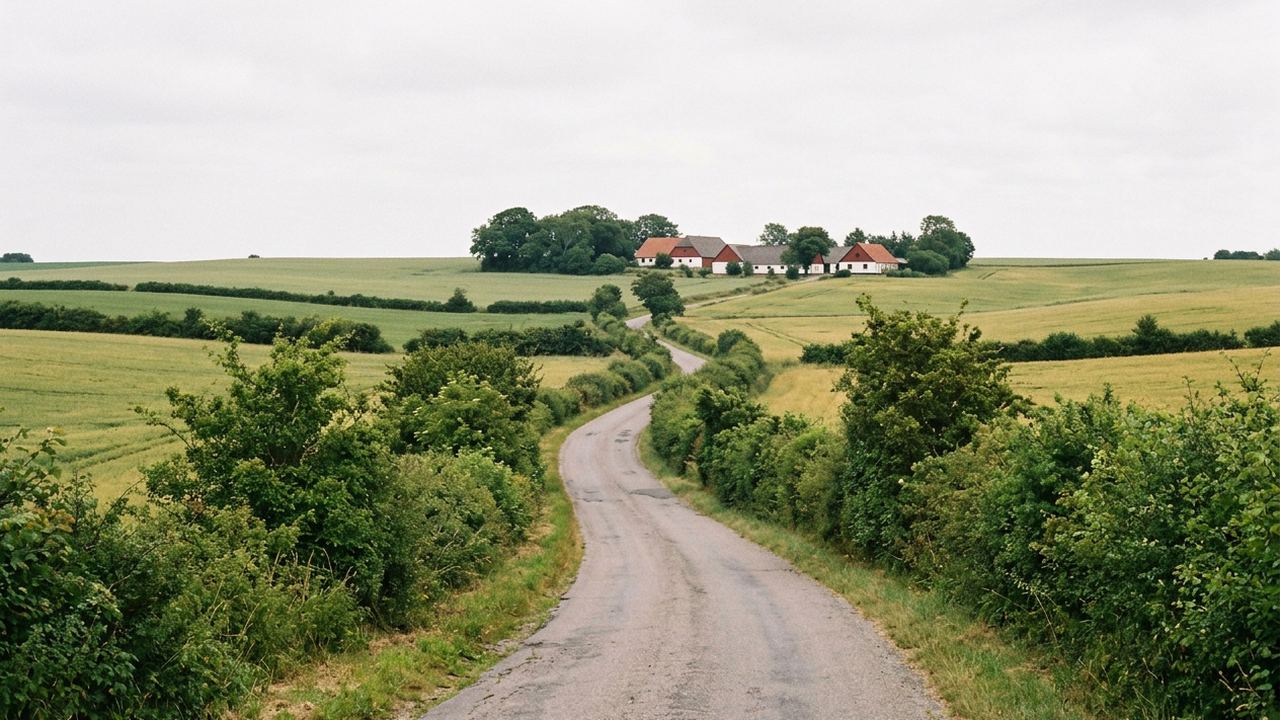
Denmark has a reputation for being flat, and most of it earns that reputation. Funen does not. The island sits between Jutland and Zealand in the middle of the country, about thirty miles across, and its southern third is a moraine ridge left by ice: ground that rises and falls in short, repeated lifts of eighty to two hundred feet. People who book a cycling week on Funen because they have been told Danish riding is level tend to say so on the second afternoon, somewhere between Faaborg and Svendborg, on the fourth lift in an hour.
What they find instead is a week with actual shape to it. The climbs are short. None of them lasts more than about half a mile, and the steepest sustained pitches on our routes sit around seven percent for a few hundred feet. The reward is that you are almost never on the same ground twice: field, beech wood, orchard, a run of coast, then a village with a church and a bakery, then up again. The north of the island, which the last two days use, does flatten out into wide arable country where the wind matters more than the gradient.
The other thing that surprises people is how short the water is. Funen is the hub of an archipelago, and the islands closest to it are joined by fixed road bridges with cycle lanes. Crossing to Tasinge takes about ninety seconds of pedaling. Crossing from Tasinge to Langeland takes a little longer and puts you high enough to see both coasts at once. Nobody stands on a quay waiting.
- What the week is
- Six nights in four places, riding twenty to forty miles a day between them on signed routes, with bags moved by road and every crossing made on a bridge.
- What sets it apart
- Funen is rolling and Aland is not: expect 900 to 1,600 feet of ascent on the bigger days here, against ground that rarely lifts more than 200 feet at a time on the other week. Crossings here are fixed bridges of a few hundred feet ridden in under two minutes, not scheduled boats. The season runs late April to mid October, roughly six months, and it is reached by a two hour train from Copenhagen airport to Odense rather than by ferry or a connecting flight. This week costs $2,270 and runs six nights; the two prices sit within a few hundred dollars of each other.
- What the figure covers
- Six nights in four small hotels and one manor guesthouse, all rooms with private bath; breakfast every morning; a hybrid or touring bicycle with rack, lock, pump and repair kit for six days; bag transfer between each of the four bases; printed route notes and a 1:100,000 route map; a GPX file for each day; a phone number for the bicycle supplier's roadside help during their working day.
- What it leaves to you
- All flights and any train to or from Odense; the two hour transfer from Copenhagen airport if you want it arranged instead of booked yourself; every lunch and every dinner; drinks with breakfast beyond what the hotel puts out; entry to the manor gardens, castles and museums along the routes, which run about $9 to $18 each; electric bicycle upgrade, currently $30 per day; child seats, trailers and tandems; anything you buy on the road; gratuities; and the cost of the return leg if you stop riding partway and take a train back to a base.
- Who this one is wrong for
- Anyone who wants a genuinely flat week, because the south and the middle of the island are neither. Anyone unwilling to ride in a headwind for an hour at a time, which the Belt supplies most days regardless of season. Riders who do not want to be on paved surfaces shared with farm traffic for stretches of two to five miles. Anyone hoping for November through March, when the routes are open but the guesthouses are shut. Anyone who will not ride at least twenty miles on consecutive days.
Ground that keeps lifting, and what the wind does to it
The riding surface is good and it is almost all paved. Denmark's national route network is signed with small blue and white plates at every junction, and three of them run through this week: the coastal route around the south, the long north to south spine, and a stretch of the Baltic route. Route notes tell you which number to follow and where to leave it. Getting lost is possible but it is a matter of a mile or two, not an afternoon.
Ascent, day by day, runs like this on the standard version: about 700 feet on the first short day out of Odense, 1,450 feet on the second, 1,600 feet on the third through the hills behind Faaborg, 900 feet on Langeland where the ridge runs down the west side, and then 400 and 350 feet on the two northern days. Distances are twenty two, thirty eight, thirty four, thirty one, twenty seven and twenty five miles. Riders who want the long version add a Langeland loop of eighteen miles and a further 600 feet.
Then there is the wind. Funen sits between two straits, and the Belt funnels air along them almost continuously. A prevailing westerly of twelve to twenty miles per hour is ordinary. It is not a storm and it is not an event; it is the condition. On the days that run west to east you will arrive early and pleased with yourself. On the two days that turn back into it, budget an extra hour and eat before you start. Riders coming from sheltered inland routes at home usually underestimate this more than they underestimate the hills.
Arriving here having asked for somewhere else
Half the people who write to this office about a Nordic cycling week have two places in mind and have not yet separated them. The rows below are the four expectations that come up most, and what each of them actually points at in facts.
Six months of open road, and what each end of them is like
The season here is long by Nordic standards, and the two ends of it are not the same week wearing different clothes. Daylight is the biggest single variable: Funen sits at fifty five degrees north, so late June gives you around seventeen hours of usable light and late September gives you about twelve.
- Late April to mid May
- Around 50 to 58F, hedges bare, orchard blossom in the south, few other riders, some restaurant kitchens still on short menus
- Late May and June
- 58 to 68F, longest light of the year, apple and rapeseed in flower, wind at its steadiest from the west
- July and early August
- 65 to 73F, the busiest weeks, coastal hotels in Svendborg and Faaborg fill four to six months ahead, harbor towns crowded
- Late August and September
- 58 to 68F, water still warm enough to swim in, harvest traffic on the farm lanes, light dropping about three minutes a day
- October to mid month
- 48 to 57F, color through the beech woods, rain days more frequent, several guesthouses close for the year mid month
- Mid October to April
- Routes remain rideable and signed, but the four places we use are shut, so we do not sell the week
From your message to a written figure
- 1. You write
- Tell us the month, the number of riders, and whether you want the standard six days or the Langeland addition. A message is read and answered before the working day ends
- 2. We check the beds
- The four bases are small, between nine and twenty two rooms, so availability is checked against your actual dates rather than a calendar. This is the step that takes the time
- 3. You get a figure
- A written quote, per person, itemizing rooms, bicycles, transfers and what is left out. Two to four working days from your first message
- 4. You decide
- The figure holds for fourteen days. Nothing is charged and nothing is held until you say yes in writing
Ask us the thing you are actually unsure about
Most useful questions to this office are specific: whether a nine year old can manage thirty eight miles, whether the September light is enough for a late start, whether two people of different speeds can ride the same day apart and meet at the same hotel. We will answer in facts about distance, ascent, surface and season, and we will not tell you which week to pick.