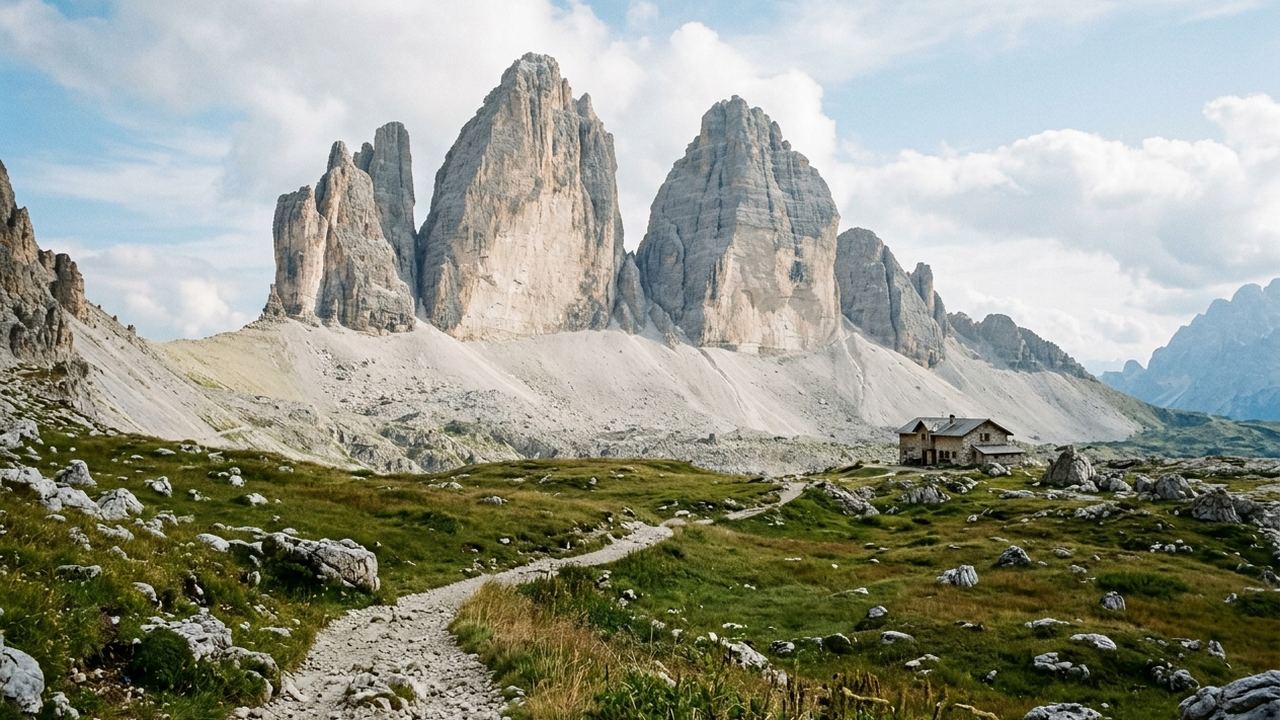
People asking about this range usually have one image in mind: a pale wall of rock standing straight up out of green pasture, photographed from a road. That image is accurate and it is also about ninety minutes of the eight days. When you book a walking trip in the Dolomites what you actually get is a week of moving between saddles, contouring under those walls rather than looking at them from below, and sleeping in buildings that sit at 6,500 to 8,900 feet with a kitchen, a bootroom and a dormitory upstairs.
The other thing people mean, often without saying it, is solitude. This range does not supply it in July. The path network was laid out by an alpine club that has been marking, numbering and maintaining these routes since the 1800s, and the huts were built to be used. On a Tuesday in early August you will pass several hundred people on a popular saddle and share a table at dinner with a dozen more.
What the density buys you is a walking week with almost no logistics. Water is available every few hours, a hot dinner is served every evening, and if weather closes in there is a roof within reach on almost every stretch.
- What the week is
- Six walking days between mountain huts on marked paths, two nights in valley hotels at either end, bags driven ahead each morning.
- What sets it apart
- The Dolomites sit about 3.5 driving hours from Venice and 2 hours from Innsbruck, with paved roads reaching most trailheads; the Julian Alps are roughly 2 hours from Ljubljana with fewer valley roads. Rock here is pale limestone in near vertical towers, and daily ascent on this route runs 1,800 to 3,200 feet. Beds are in staffed huts with dormitories and a fixed dinner hour, not in hotels. Huts open roughly late June to late September, and July and August fill months ahead. This trip is $3,240 per person for eight nights.
- What the figure covers
- Eight nights of beds, six in staffed mountain huts and two in valley hotels; half board every night, meaning dinner and breakfast; bag transfer by road between valley points and to the two huts a vehicle can reach; a marked route file and printed day notes with distances and ascent in feet; one arrival briefing; a written contact for the whole week.
- What it leaves to you
- Flights, and any train or bus to the valley; lunches, drinks with dinner, and anything from the hut bar; the small nightly surcharge some huts add for a private room where one exists, when it can be had at all; cable car and chairlift fares, which on this route run about $12 to $30 a ride and are optional on four of the six days; luggage transfer for the two nights when the hut has no vehicle access and you carry a small overnight bag; parking at the valley hotels; anything you would buy on a rest day.
- Who this one is wrong for
- Anyone unwilling to sleep in a room with strangers, since four of the six hut nights are dormitory beds sold by the bunk. Anyone who wants a shower every night, as two huts ration hot water by the coin. Anyone who needs to eat later than about 7:30pm, when hut kitchens close. Anyone set on late May or early October, when most huts on this line are shut and the route does not exist as a walking week. Days are 5 to 8 hours on foot with sustained ascent on stone paths and some cable-protected sections where hands are used on rungs.
Limestone underfoot, and what that does to a day
The rock is dolomite: pale, blocky, and it weathers into towers with slabs and scree at the base rather than into rounded ridges. Practically this means paths are stony almost all day. There is very little soft ground. Ascent tends to come in one or two concentrated climbs of 1,200 to 1,800 feet rather than spreading itself across the day, because the route is forever getting from one basin into the next over a notch in a wall.
Four of the six days include short cable-protected sections. These are fixed steel lines and iron rungs bolted into rock on ground steep enough that the club decided walkers wanted something to hold. They are not climbing routes. They typically run 60 to 200 feet, and you will use your hands. Any of them can be bypassed on this itinerary, but the bypass adds 45 to 90 minutes and about 500 feet.
Daily distances run 6 to 11 miles. That sounds modest and it is not, because the stone slows you down. Plan on 5 to 8 hours moving, plus stops. Afternoon storms build over the walls with real speed in July and August, which is why huts want you in by mid afternoon and why almost every day here starts before eight.
Arriving with the other range in mind
Two ranges get asked for interchangeably, and the request usually contains one specific wish that points cleanly at one of them.
Eight months of the year this route does not exist
The walking season is set by the huts, not by the snow. Most staffed huts on this line open in the last week of June and close in the last week of September, and outside those dates the itinerary has nowhere to sleep. Snow lingers in north-facing gullies into early July, and the cable-protected sections can hold ice on a cold morning well after the huts open.
- Late June
- Huts opening, snow in north gullies above 8,000 feet, long daylight, beds available at short notice
- July
- Warm, 70 to 78F in the valleys and 45 to 60F at hut altitude, afternoon storms most weeks, huts full and booked months ahead
- August
- Busiest of the year, Italian holiday weeks in the middle of the month, every bunk spoken for, paths crowded at the saddles
- Early September
- Storm frequency drops, mornings around 35 to 40F at the huts, most beds still open, best light of the season on the walls
- Late September
- Huts closing one by one, first snow possible above 8,500 feet, route becomes unreliable within days
- October to May
- No staffed beds on this line at all
From your message to a written figure
- 1. You write
- Tell us your month, your group size and whether dormitory beds are acceptable. A message is opened before the working day ends
- 2. We check beds
- Hut availability is confirmed for your exact dates before any figure is quoted, since a week here is only real if eight beds exist. For July and August this often means asking about the following year
- 3. You get a figure
- A written breakdown per person, showing which nights are huts and which are hotels, where bags travel by road, and where they do not. Two to four working days
- 4. You decide
- Nothing is held and nothing is charged while you think. If you go ahead, hut deposits are placed and the day notes follow
Ask about a month, not a mood
If you tell us the two weeks you can actually take off, we can tell you within a few days whether beds exist on this line, and what the same eight nights look like in the other range people ask about alongside this one. We will lay both out in facts. Choosing between them is yours.