The Alpujarras occupy the southern slope of the Sierra Nevada, between the high snow and the coastal plain, and the whole inhabited band sits between 3,000 and 5,000 feet. When people ask us to book a walking week in the Alpujarras they usually have one photograph in mind: white cubic houses stacked up a gorge wall, flat clay roofs, chimneys with little hats on them. That is Pampaneira, Bubion and Capileira, three villages in the Poqueira valley, and you will walk through all three. What tends to surprise is everything around them.
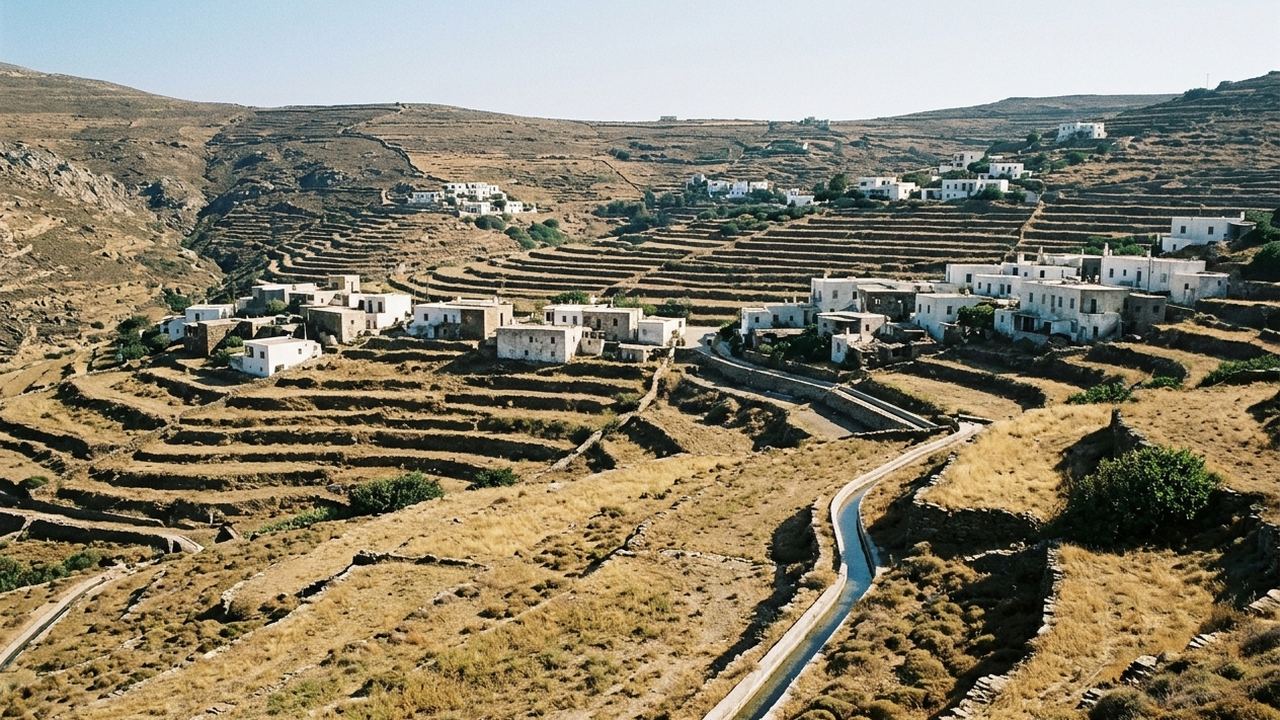
The ground is farmed. It has been farmed for a very long time, and the reason it can be farmed on a south-facing slope in Andalusia is a network of open irrigation channels, the acequias, that carry snowmelt sideways across the hillside at a shallow gradient. Many of the walking routes here follow those channels, because a channel is by definition a contour line that somebody has already leveled. So a day can hold 1,800 feet of ascent and still contain two hours of near-flat walking beside running water, under chestnut and walnut, with the whole coastal plain dropping away to your right.
The second surprise is the calendar. This walk is offered from October to May. It is not offered in July or August, because the terraces are exposed and the temperature on them regularly passes 95F before noon. That single fact is the most useful thing on this page, and it is the reason so many people end up comparing this week with the Picos de Europa week, where the arithmetic runs exactly the other way.
- What the week is
- Six walking days between five villages on the south flank of the Sierra Nevada, with bags moved by road each morning and a fixed bed each night.
- What sets it apart
- The Alpujarras season runs October to May and the Picos season runs June to September, so the two weeks do not compete for the same months; daily ascent here sits between 1,300 and 2,400 feet against 2,500 to 4,000 feet in the Picos; the ground is terraced farmland and irrigation channel with hard surfaces underfoot, not limestone gorge and scree; Malaga to the first village is about 2 hours by road, Bilbao or Santander to the Picos is 2 to 3 hours; the floor here is $2,090 per person and the two weeks are priced within a few hundred dollars of each other.
- What the figure covers
- Seven nights in village guesthouses, all rooms with private bathroom; breakfast daily and five evening meals; bags moved by road between villages on all six walking days; printed route notes and marked mapping for every stage; one local walking guide for the two highest stages; airport transfer from Malaga on arrival and back on departure; a named contact reachable in writing for the whole week.
- What it leaves to you
- Flights to and from Malaga; two evening meals and all lunches; drinks with any meal; any food or coffee bought on the trail; entry to the historic houses in Pampaneira and Bubion; taxis taken by choice on a walking day; anything bought at the Thursday market in Orgiva; laundry; tips; any medical or personal cover you choose to arrange yourself; car hire if you want a vehicle for the days off.
- Who this one is wrong for
- Anybody who wants to walk in July or August, when the terraces run past 95F by mid morning and this week is not offered; anybody who cannot handle three to six hours on foot six days running; anybody who finds steep concrete and cobble hard on the knees, because the descents into the Poqueira gorge are surfaced and steep for over 1,000 feet at a stretch; anybody who wants snow underfoot, which sits above this route and not on it.
Terraces, channels and what your legs actually do
Six walking days, three to six hours each, 1,300 to 2,400 feet of ascent per day. The longest single climb on the week is the pull out of Capileira toward the Mulhacen approach path, which gains about 2,400 feet over roughly four miles before turning back down. Nothing on the route requires hands on rock and nothing crosses a section where a slip carries consequence beyond a scraped shin.
Underfoot matters more here than gradient. A good half of the mileage is on old mule tracks surfaced with cobble, and the descents in and out of the Poqueira gorge are steep, hard and often concreted for stretches of a thousand feet or more. Walkers who are comfortable on soft mountain ground sometimes find these surfaces the tiring part of the day. Poles do more work here than boots do.
Distances between villages are short, which is why the week works village to village at all. Pampaneira to Bubion is under a mile on foot with 600 feet of climb. Bubion to Capileira is barely longer. Further east, Trevelez sits at about 4,840 feet and is the highest village on the route; the walk in from Busquistar follows an acequia most of the way. Because the villages are close, a day can be shortened on the ground without stranding anybody, and there is a paved road within reach of every stage.
People who asked for something else first
Half of the people who write to us about this week arrived at it sideways. They wanted a specific thing, and this valley either is that thing or points somewhere adjacent. We would rather name the mismatch in the first message than in the third night's dining room.
The year runs backward here
The season is the whole argument. Winter is walking weather on these terraces: cold at dawn, warm by eleven, dark early. Summer is not, and we do not pretend otherwise by putting a departure in it. The wettest stretch is short and falls in late fall.
- October to mid November
- Warm afternoons around 70F, long daylight, chestnut harvest, the busiest weeks we sell
- Late November to January
- Cold mornings near 40F, clear light, snow visible above 8,000 feet, quiet villages, some guesthouses on reduced service
- February to March
- Cold and often the driest run of the year, almond blossom below 3,500 feet, short daylight
- April to May
- Around 75F, water high in the channels, wildflowers on the terraces, the second busy period
- June to September
- Not offered as a walking week; terraces regularly above 95F by mid morning
- Fills first
- Late April, early May and the two weeks either side of Spanish Easter
From your message to a written figure
- 1. You write
- Tell us the month you have in mind and how many of you there are; a message is opened before the working day ends
- 2. We check beds
- Five villages, small guesthouses, few rooms each; we confirm what is actually free for your dates before quoting anything
- 3. A figure in writing
- Two to four working days, itemized per person, showing what is in and what is not, with the walking days and their ascent listed
- 4. You decide
- Nothing is held against you until you say yes in writing, and no payment is taken through this site
Ask us the awkward one
If you are weighing this week against the northern one, tell us both and tell us your month. We will set out the ascent, the surfaces, the transfer times and the two figures side by side and leave the choosing to you. We will not tell you which valley you would prefer, because we do not know that and neither does anybody who has not met you.