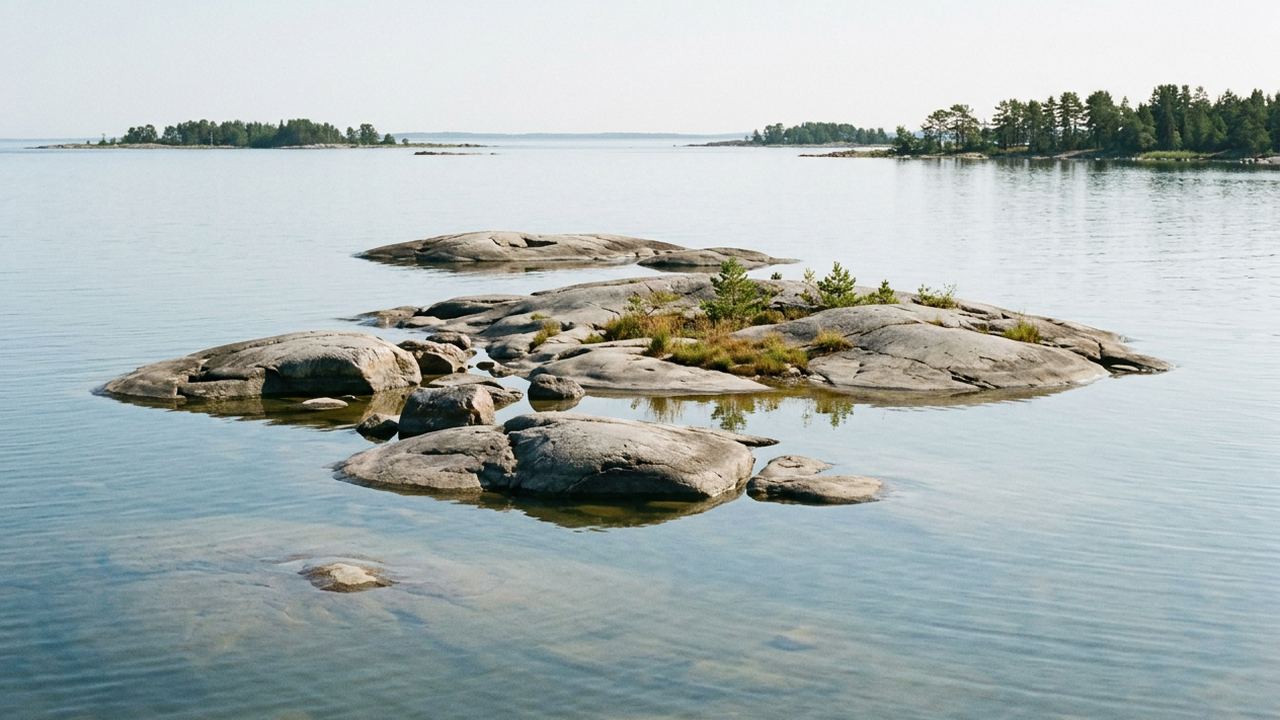
The highest point in the whole archipelago is 423 feet above the sea, and you can ride for four days without seeing anything that deserves the word hill. People who ask us to book a cycling week in the Aland islands have usually been told it is flat and easy, and the flat part is entirely true. What they have not usually been told is that the archipelago is not one place. It is roughly 6,700 islands and skerries, of which about 60 have people living on them, and the roads between them are boats.
Those boats are the week. The main island, Fasta Aland, is joined to its nearer neighbors by bridges and causeways, and you can ride that part on your own clock. Beyond it, in the eastern and northern chains, the road simply stops at a slipway and a small yellow ferry comes to continue it. Bicycles travel free. So do foot passengers. Cars pay on some routes. What you cannot do is negotiate with the timetable: on the busier crossings there are eight or ten sailings a day, on the quieter ones there are two, and if you arrive at the slipway eleven minutes after the 2:15 has gone, the next one is at 6:40 and you have an afternoon on a wooden bench with a thermos.
We say this early because it is the single fact that decides whether somebody enjoys this week or spends it frustrated. Riders who treat the timetable as the itinerary have a very good time. Riders who treat it as an obstacle do not.
- What the week is
- Six nights across four islands, bicycles carried free on the yellow inter island ferries, luggage moved by road on the main island and by boat beyond it, riding days of 18 to 34 miles on near flat ground.
- What sets it apart
- Aland sits about 25 miles off the Swedish coast in the Baltic and is reached by an overnight or daytime crossing rather than a bridge, so arrival day is a travel day; total ascent across six days is under 1,400 feet against Funen's rolling interior; the season is short, roughly early June to the first week of September, and several island ferries drop to two sailings a day outside July; the figure here is $2,410 per person against a different figure on the Funen page, and the gap is mostly the boats.
- What the figure covers
- Six nights in guesthouses and small family hotels, all with private bathroom; breakfast every morning; four dinners; bicycle hire with panniers, pump, spare tube and helmet; luggage moved between overnight stops; a printed route book with the current sailing times for every crossing on your itinerary; a Finnish mobile number answered in English for the whole week.
- What it leaves to you
- Travel to and from Aland, including the Baltic crossing from Stockholm, Turku or Helsinki; two dinners; every lunch; all drinks; the harbor sauna fees that most guesthouses charge separately; bicycle upgrades to electric assist; entry to the maritime and open air museums; anything you buy on the boats; and gratuities.
- Who this one is wrong for
- Anyone who needs a fixed daily schedule, because a missed ferry rearranges the afternoon and there is no second boat on some crossings; anyone unwilling to ride 18 to 34 miles in open wind, which on exposed causeways is the whole difficulty of the week; anyone traveling between October and April, when most guesthouses close and the small ferries cut back to a winter service; and anyone wanting mountains, because there are none.
Ground that never rises, wind that never stops
The riding surface is asphalt for almost all of it, laid over glacial rock, and it is in good repair because the winters here are salt free. Between the bridges you get short gravel sections, firm and rolled, no more than two or three miles at a stretch. A touring bicycle handles the whole route. Total ascent across the six days comes to under 1,400 feet, and most of that is the ramp up off one ferry slipway or another.
What replaces the climbing is the wind. Aland lies in open Baltic between Sweden and Finland with nothing tall on it, and the prevailing southwesterly crosses the causeways without interruption. On an exposed stretch like the run out toward Eckero, a 22 mile day into a fresh headwind takes the same effort a hilly 30 would elsewhere. This is not a warning, it is a description: it is the only physical difficulty the week contains, and it is the reason we do not sell this as an easy week just because it is a flat one.
Distances are genuinely short. Days run 18 to 34 miles, with the longest usually the crossing of Fasta Aland from Mariehamn toward the northeast. Traffic is light outside the July peak, and the main north south road carries most of what there is, so the smaller lanes are often empty for an hour at a time. Everything is signed in Swedish, which is the sole official language of the islands even though they are Finnish territory; Finnish is rare here, and English is widely spoken in the harbors and guesthouses.
People who arrive here having asked for somewhere else
Roughly a third of the people who write to us about this week are describing something that is not quite this week. That is not a mistake on their part. Aland is described in very general terms by most of what is written about it, and the description fits several different places.
Six weeks that carry the season
The usable season is short and everybody knows it, which is why the middle of it fills first. Midsummer week and the whole of July book out earliest, and the guesthouses on the smaller islands have between four and nine rooms each, so there is not much slack. June and late August are quieter on the roads and on the boats, and the ferries are still on summer sailings through the last week of August.
- Early June
- Around 57 to 63 Fahrenheit, long light until near midnight, summer ferry timetable begins, some kitchens not yet open daily
- Midsummer to mid July
- Warmest and busiest, 63 to 72 Fahrenheit, all sailings running, rooms gone by February most years
- Late July to mid August
- Still warm, water at its highest temperature, road traffic easing after the first week of August
- Late August
- 55 to 66 Fahrenheit, summer sailings still in force, most guesthouses open, quietest riding of the season
- Early September
- Cooling fast, reduced sailings begin on several outer routes, some guesthouses close for the year
- October to April
- Winter timetable, most accommodation shut, we do not run this week
From your message to a written figure
- 1. You write
- Tell us the month, how many of you, and whether anyone wants electric assist. Your message is opened before the working day ends
- 2. We check the boats first
- Before anything else we lay your dates against the current sailing times, because on two of the crossings a two sailing day makes certain overnight pairings impossible
- 3. We check the rooms
- Four to nine rooms per guesthouse on the small islands means availability, not price, decides the shape of the route
- 4. You get a figure
- A written itinerary with the per person cost, every crossing named with its sailing times, and what is not in the price. Two to four working days
Ask us the awkward question
The useful questions are usually the specific ones: what happens if it rains for two days, whether a particular crossing has a morning boat, whether 34 miles is realistic for the slowest person in your group. We would rather answer those before you commit than after. If you are weighing this against the Funen week, ask us for both figures and both route profiles and read them side by side; we will set out what each involves and leave the choosing to you.